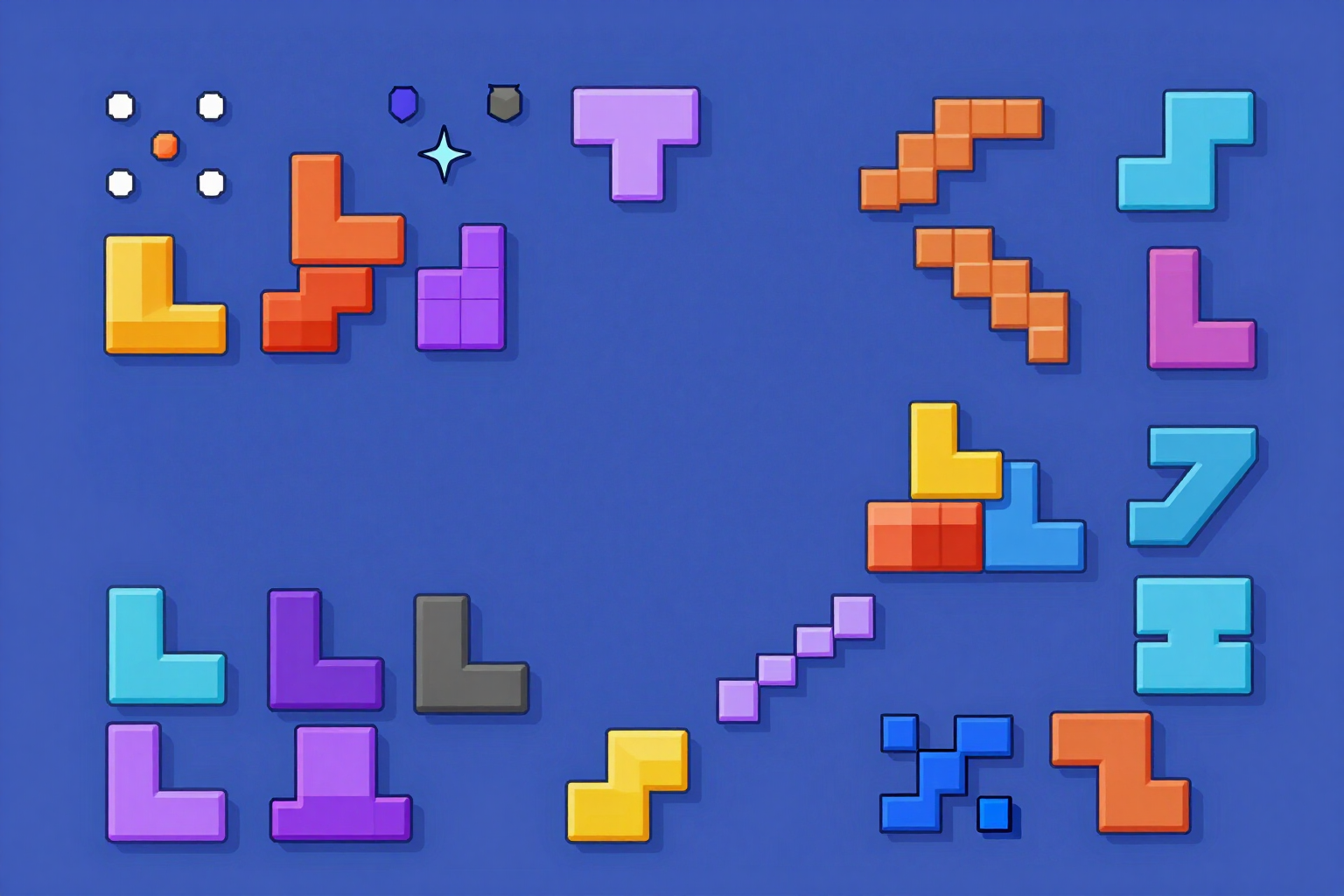
Block Blast!'s 33 pieces, with their version and date in plain sight
Seven families, 33 shapes drawn one by one, and an uncomfortable fact stated plainly: the game's real set isn't public, so this catalog starts marked UNVERIFIED and gets corrected without updating the app.
Almost no block puzzle tool tells you which pieces it's calculating with. This one puts them all up front, grouped, and tells you what date they're from.
The piece catalog is the piece of data everything else depends on. When you pick your three pieces for the turn, you do it from a palette of 33 shapes grouped into seven families — Single, Lines, Blocks, 3-cell L, 4-cell L and J, S and Z, and T — browsed with tabs on the move screen. Each shape is drawn from its real cell geometry, not a loose image: what you see on the chip is exactly the mask the engine tries to place on your board.
That same catalog is the reference the solver uses to measure whether your board is still alive. The fit-capacity metric shown next to each move — "33 of 33 pieces still fit" — is calculated by trying each of the catalog's 33 shapes one by one on the board that would result. If the catalog changes, the metric changes: that's why it isn't hidden in the code, but shown in plain sight with its version number.
And here's the part almost nobody publishes: the exact set of Block Blast! pieces isn't documented by its developer. What you see is the standard set of polyominoes used in blast-type games, and it starts marked as UNVERIFIED, version 1.0, with a reference date of November 2, 2026. The notice appears in the app itself, below the palette and in the board diagnosis: "Data v1.0 UNVERIFIED: check them against your game." We'd rather tell you than have you find out.
Rotation is the other versioned piece of data in the same block. In Block Blast! pieces aren't rotated, so the catalog treats each orientation as a different piece: that's why there are eight 4-cell L and J variants, and four T variants. The engine doesn't generate rotations on its own; it obeys that catalog flag. If that data turns out to be wrong someday, it's changed in the service configuration and the whole app finds out without touching a line of code or waiting for a store update.
Try The 33 pieces right here
Use it free without an account. If you want to save your result, you can sign up afterwards.
Save / Sign upBenefits of The 33 pieces
The 33 shapes, shown up front and grouped
seven families with tabs (Single, Lines, Blocks, 3-cell L, 4-cell L and J, S and Z, T) instead of an endless list where you can't find the piece you got.
What you see is what's calculated
each chip is drawn from the piece's real cells, the same mask the engine tries on your board. There isn't a pretty catalog for the screen and a different one underneath.
Version and date on screen, not in the fine print
the "Data v1.0 UNVERIFIED (ref. 2026-11-02)" stamp sits below the palette and in the diagnosis. You know how current the data you're playing with is.
What's unverified is stated
Block Blast!'s set of pieces isn't published by its developer. This is the standard set used by blast-type games, and we say so before you trust it more than you should.
No rotation, because the game doesn't rotate
each turn is a separate catalog piece (eight 4-cell L and J, four T). The solver doesn't invent orientations the game won't let you use.
It gets corrected without waiting for an update
the catalog lives in the service configuration, not inside the app's bundle. If a missing piece shows up or a nonexistent one does, it's fixed and you have it on reload.
It's the basis for the other figures
each move's fit metric and the uniform piece draw of the 500-game benchmark both rest on these 33 shapes. Showing them is the only way you can scrutinize the result.
See the 33 pieces and try the solver with your own
Open the palette, pick the three pieces you got, and get the move for the turn. Free, no registration, no usage limit.